


Last weekend, I played one of the worst tournament rounds I’ve had in years.
By the third hole, I was shanking irons.
The spiral had started on the first.
After a poor tee shot, I hit a high, pure 6-iron into a spot from which I could get up and down for par. My partner thought one of our opponents had hit his approach to two feet. The pin was tucked directly behind a bunker.
My instinct was to play toward the middle of the green. Give myself a 20 or 30-foot putt at par. At worst, make bogey. Because I received a handicap stroke on the hole, that would still be a net par and might be enough to tie.
But if our opponent was really two feet away, the conservative play probably wasn’t enough.
“I’d have to hit this perfectly,” I told my partner. “I’d have to carry the bunker right at the tucked flag.”
“You need to,” he said.
So I tried.
And I hit it well.
The ball flew directly at the flag, came up a couple of yards short of clearing the bunker, and dropped into the sand.
I made double.
It turned out our opponent wasn’t two feet from the hole. He had gone over the green. Then he skulled his next shot back across the green in the other direction. His partner made par.
Had I played the shot I originally believed was correct, we probably would have walked away with a tie.
But the more damaging mistake wasn’t the double. It was the story I told myself about it.
On the next tee, I hooked my drive into a fairway bunker. Suddenly I was worried about hitting hooks. I started steering the club, trying to control the ball and prevent another miss.
On the third hole, a par 3, I told myself to relax.
Just swing. You’ve got this.
I tried to be loose. I tried to trust my mechanics.
But I never really chose a target or pictured a golf shot. I was simply trying to make a good swing.
I hit an 8-iron off the hosel 30 yards to the right.
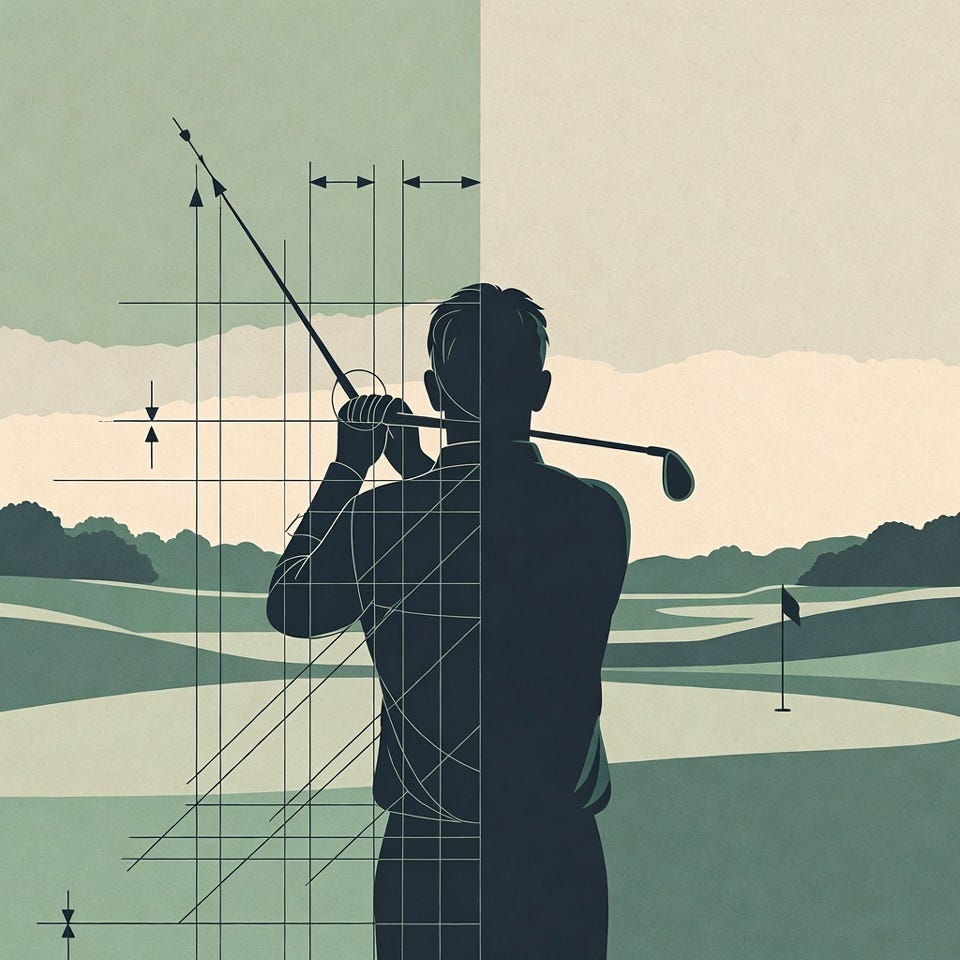
Then every shot became a debugging session.
Maybe my takeaway was too far inside. Maybe my wrists were rolling open. Maybe I needed a more in-to-out path. Maybe I wasn’t getting to my lead side.
The irony was that the shot that started the spiral wasn’t a mechanical failure at all. I had made a good swing attached to a decision with almost no margin for error.
I had attached the debugger to the wrong process.
The mistake was in the judgment, not the swing.
If you’ve spent your career building systems, this instinct probably feels familiar. When something behaves unexpectedly, you diagnose it. You isolate variables. You search for the fault.
That is part of what makes me good at my job. I’m a CTO. I solve problems for a living.
Apparently, I was trying to do the same thing in the middle of a full-speed golf swing.
Instead of playing golf, I was debugging golf.
the ball mark
On the drive to work Monday morning, I listened to Bob Rotella’s Golf Is Not a Game of Perfect.
One idea stayed with me:
Once you have made the decision, stop thinking about your swing. Choose a precise target. Look at the target. Look at the ball. Swing.
Simple.
Almost too simple.
My shorthand became LLS: Look. Look. Swing.
Then I remembered two of the best shots I had hit all weekend.
Both were short pitch shots. On each one, I chose someone else’s ball mark as my landing spot.
Not the green.
Not “somewhere around the hole.”
One specific ball mark.
I could see the shot before I played it: the ball landing directly on that mark, taking its first bounce, and rolling toward the hole.
I wasn’t thinking about my wrists. I wasn’t monitoring my weight shift. I wasn’t telling myself to accelerate or use the bounce.
I was trying to land the ball there.
Both shots landed almost exactly where I had pictured them.
Two shots don’t prove a theory. But the contrast was hard to ignore.
When I gave my body a precise external task, it organized the movement.
When I told myself to make a good swing, I started monitoring the movement.
two seans
That afternoon, I realized I had been bringing the wrong version of myself into the shot.
I have two versions of myself.
Engineer Sean builds the golf swing.
He watches video. He experiments with drills. He finds useful feels. He writes notes. He studies launch-monitor data.
He is genuinely helpful.
He belongs on the driving range.
Then there is Golfer Sean.
Golfer Sean doesn’t care about path numbers. He sees a golf shot: the ball starting over a particular branch, landing on a patch of grass, and releasing toward the hole.
He can visualize the shot, feel it in a rehearsal swing, and then execute it.
He just wants a destination.
The problem wasn’t that Engineer Sean’s observations were wrong.
My setup really had changed during the tournament. I had started aiming too far right. My takeaway had moved too far inside. I was rolling the clubface open early.
Those were real symptoms.
The problem was timing.
I was trying to correct them between tournament shots, and eventually during them.
The mistake wasn’t bringing Engineer Sean to golf.
The mistake was letting him hit the shot.
That evening, I went out to play nine holes with my wife.
On the way to the first tee, she reminded me, correctly, that I needed to schedule a colonoscopy.
She was right. I do need to schedule it.
That did not prevent us from getting into a small argument.
I had planned to spend the round thinking:
LLS.
Instead, I arrived at the first tee thinking something closer to:
FFS.
The first few holes were not good.
I went through the sequence. I looked toward the target. I looked back at the ball. I swung.
But my attention wasn’t really there.
The words were present. The intention wasn’t.
That was useful to learn. A pre-shot routine is not an incantation. Looking at a target only works when I actually give the target my attention.
For much of the round, I felt as though I couldn’t complete my backswing. I tried creating a longer pause at the top. That helped a little with the driver, but I still wasn’t compressing my irons.
Eventually, I let Engineer Sean have one rehearsal swing.
For a moment, I felt my left shoulder point down toward the ball as I started the backswing. It was an old cue, something that seemed to help me stay centered and complete my turn.
Then I let the cue go.
I stepped in.
I chose the target.
I looked at it, looked back at the ball, and swung.
I flushed an iron.
Then I flushed another.
It was that dense, effortless strike golfers recognize immediately. You know before you look up. The ball feels as though it stayed on the face for an extra fraction of a second, then leaves on the exact flight you imagined.
My mood changed instantly.
Not because I had discovered the perfect swing.
Because I remembered that I already had one.
The mechanical cue mattered. But so did where I used it.
The cue belonged in the rehearsal. The shot belonged to the target.
the note I had already written
When I got home, I opened my golf notes.
I have pages of Google Keep entries going back to 2018. I expected to find a progression of new theories, new mechanics, and newly discovered solutions.
Instead, I found versions of the same reminders appearing over and over.
Loose hands.
Skip the stone down and just past the ball.
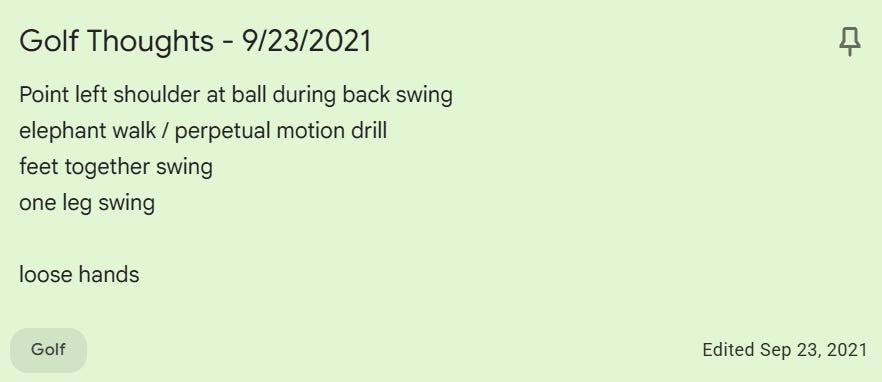
Point the left shoulder at the ball during the backswing.
Get to the front foot and turn.
Thump the ground an inch beyond the ball.
Swing through the ball toward the target.
Hold the balanced finish until the ball lands.
One note from 2021 contained the left-shoulder cue I had just “discovered” again.
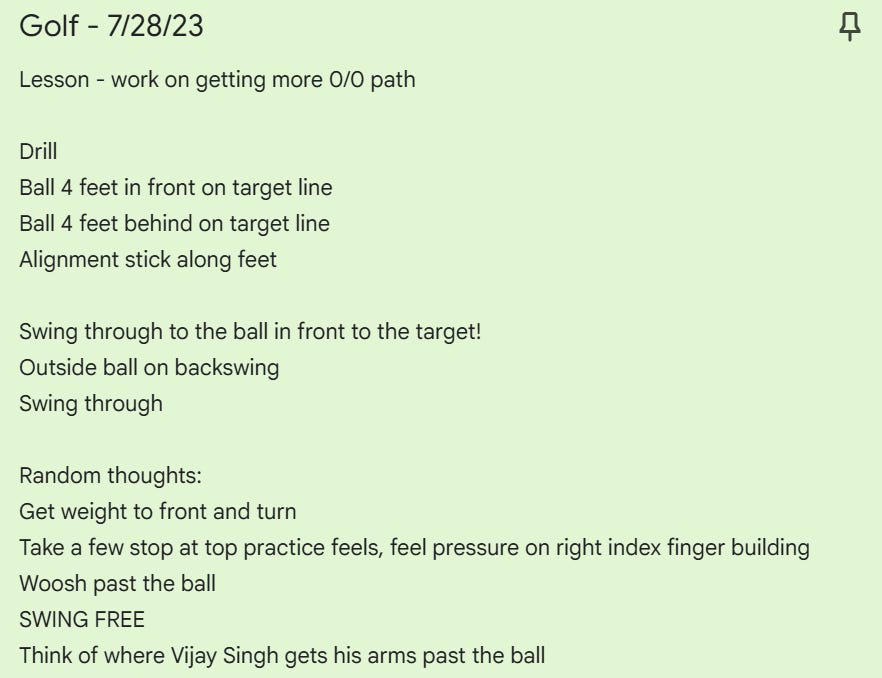
A note from 2023 told me to place an intermediate target in front of the ball and swing through it toward the actual target.
A note from a David Glenz golf school in 2018 emphasized rhythm, balance, and holding the finish.
The exact cues weren’t always the same. Some were responses to whatever mistake I was making at the time. Some probably worked until I exaggerated them and created a different problem.
I wasn’t uncovering one permanent mechanical secret.
I was repeatedly rediscovering the conditions under which I swing like myself:
Freedom.
Athletic movement.
A clear destination.
A complete finish.
I kept rediscovering the same golfer.
Then I found a note dated June 5, 2018.
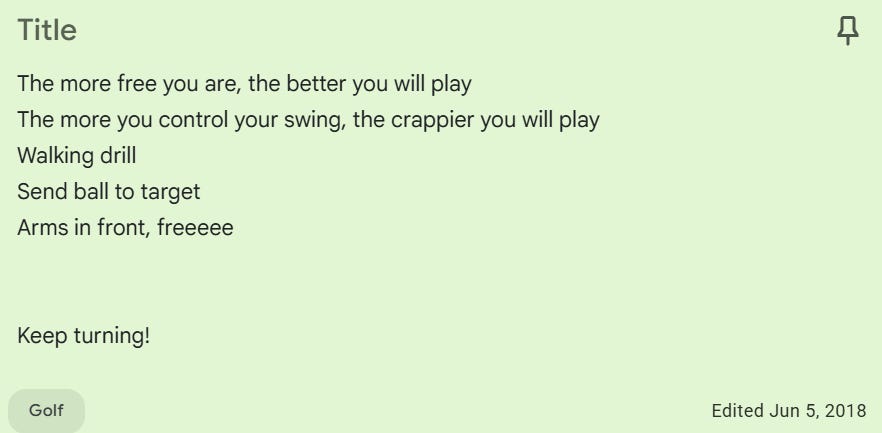
It read:
The more free you are, the better you will play. The more you control your swing, the crappier you will play.
I had already written the entire thesis of this essay eight years earlier.
Then I forgot it and went back to debugging.
development and production
This isn’t only a golf story.
It is a story about expertise, and about knowing when to switch modes.
At work, we separate development, testing, and production.
Development is where you experiment. Testing is where you isolate variables, inspect behavior, and make corrections. After deployment, you examine logs and evaluate what happened.
The driving range is development.
Video and launch-monitor sessions are testing.
Post-round notes are logs.
The golf course is production.
Production is not where you insert a debugger into every transaction because one result surprised you. You execute the system you prepared, observe what happens, and make controlled changes later.
I had blurred those environments.
Analysis was never the enemy. Mechanical work was never useless. Engineer Sean had built a golf swing capable of producing some very good golf.
But he had started treating every poor result as evidence that the system needed to be redesigned immediately.
He was trying to refactor the application while it was running.
Performance is the reward for preparation, not another opportunity to redesign the system.
I still need Engineer Sean.
He is welcome on the range. He is welcome reviewing video after the round. He can read golf books, study patterns, and experiment with a familiar feel.
He may even get one rehearsal swing when I genuinely need a reminder.
Then his work is done.
Golfer Sean’s checklist is much shorter.
See the shot.
Choose a precise target.
Look at the target.
Look at the ball.
Swing.
I have another event on Wednesday.
I may play well. I may not. I will almost certainly hit at least one poor shot.
The test is not whether I can eliminate bad shots.
The test is whether one bad result becomes evidence that the entire system needs to be rebuilt.
Somewhere underneath all the analysis, Golfer Sean has been saying the same thing my notes have said since 2018:
Give me a target. Let me move. I’ve got this.
Engineer Sean built the swing.
Golfer Sean gets to play it.